

Kenneth T. Norris Prof of Psychiatry @Stanford; Uytengsu Director of @BrOrganogenesis; Physician-Scientist; Seeking to understand human brain assembly & disease
Stanford, CA 🇺🇸
- Tweets 2,228
- Following 1,719
- Followers 15,194
- Likes 3,796


Pinned Tweet

Today in @Nature, we report a new approach to studying human brain development and modeling disease in vivo.
Human neural #assembloids and #organoids have opened new ways to study development in vitro, but they also have important limitations. Transplantation can provide a more physiological environment, yet human cortical cells then develop within a rodent brain that matures much faster, constraining their growth and integration.
To address some of these limitations and obtain more advanced functional readouts relevant to disease biology, we generated #apallial mice, in which ~98% of the cortex and hippocampus fail to form, creating space for transplanted human cortical organoids to grow and integrate extensively.
We call these #xenocortical mice (XCX).
Nearly 7 years in the making. Congratulations to an extraordinary team and wonderful collaborators!
Link to the article below 👇

60
251
1,783
611,328
Here’s a short summary of our recent #xenocortication article in @Nature, including the rationale, approach, key findings, initial applications to disease modeling, and current limitations.
A tremendous effort led by Konstantin Kaganovsky, Kevin Kelley, Tilo Gschwind, and Paul Harary.
Link to the article below

2
13
64
2,991
Superb work from Helen Bateup’s lab in @Nature this week, led by the remarkable Tommy Li, a former PhD student here at Stanford.
Using regionalized cortical #organoids, they show that loss of TSC2 biases neural progenitors toward enlarged, pro-inflammatory reactive astrocytes, pointing to glia as major players in tuberous sclerosis.

1
6
87
6,395
Article here: nature.com/articles/s41586-0…
2
541
Sergiu P. Pasca retweeted

Research led by @MountSinaiNYC, featured in landmark collection of 9 papers, represents one of largest & most comprehensive applications of single-cell genomics to human brain disease research. Learn More 👉 mountsinai.org/about/newsroo…

3
15
51
6,140
More on the science and motivation behind the work in @Nature this week
med.stanford.edu/news/all-ne…

Today in @Nature, we report a new approach to studying human brain development and modeling disease in vivo.
Human neural #assembloids and #organoids have opened new ways to study development in vitro, but they also have important limitations. Transplantation can provide a more physiological environment, yet human cortical cells then develop within a rodent brain that matures much faster, constraining their growth and integration.
To address some of these limitations and obtain more advanced functional readouts relevant to disease biology, we generated #apallial mice, in which ~98% of the cortex and hippocampus fail to form, creating space for transplanted human cortical organoids to grow and integrate extensively.
We call these #xenocortical mice (XCX).
Nearly 7 years in the making. Congratulations to an extraordinary team and wonderful collaborators!
Link to the article below 👇
1
3
44
6,327
Our latest article on #xenocortication using neural organoids is in @Nature this week

Today in @Nature, we report a new approach to studying human brain development and modeling disease in vivo.
Human neural #assembloids and #organoids have opened new ways to study development in vitro, but they also have important limitations. Transplantation can provide a more physiological environment, yet human cortical cells then develop within a rodent brain that matures much faster, constraining their growth and integration.
To address some of these limitations and obtain more advanced functional readouts relevant to disease biology, we generated #apallial mice, in which ~98% of the cortex and hippocampus fail to form, creating space for transplanted human cortical organoids to grow and integrate extensively.
We call these #xenocortical mice (XCX).
Nearly 7 years in the making. Congratulations to an extraordinary team and wonderful collaborators!
Link to the article below 👇
5
18
84
10,288
Thank you @Carolynyjohnson for the thoughtful coverage of the work.

Today in 🤯 science: A team led by @Sergiu_P_Pasca engineered mice to be missing a large swath of their brains. Next, they transplanted human brain organoids, which grew and filled in the void. They're still mice, but with a human-dominated cortex. nytimes.com/2026/09/16/scien…
1
2
23
8,816
More here: med.stanford.edu/news/all-ne…
4
29
26,289
Today in @Nature, we report a new approach to studying human brain development and modeling disease in vivo.
Human neural #assembloids and #organoids have opened new ways to study development in vitro, but they also have important limitations. Transplantation can provide a more physiological environment, yet human cortical cells then develop within a rodent brain that matures much faster, constraining their growth and integration.
To address some of these limitations and obtain more advanced functional readouts relevant to disease biology, we generated #apallial mice, in which ~98% of the cortex and hippocampus fail to form, creating space for transplanted human cortical organoids to grow and integrate extensively.
We call these #xenocortical mice (XCX).
Nearly 7 years in the making. Congratulations to an extraordinary team and wonderful collaborators!
Link to the article below 👇
60
251
1,783
611,328
Thank you @NitaFarahany. Very grateful for your thoughtful reflections, and for the very useful discussions

In an extraordinary new paper, just out, in Nature @Sergiu_P_Pasca and his team genetically altered mice to make them "apallial" (missing a cortex). And then, postnatally, transferred organoids derived from human neural cells into that space.
Three months later, in the animals measured, the cortex was 91.9% human-derived neural cells by volume.
The result is not quite a mouse mouse (albeit I would still say, it's a mouse!), and certainly not anything like a human. Nothing the researchers measured suggests these animals have human-like experiences.
What a model like this promises for neurological disease modeling and drug discovery cannot be overstated. It's nothing short of an extraordinary breakthrough.
It also raises complex ethical questions (to be clear, these researchers carefully engaged external ethicists (I was one of them), and followed every ethical and legal guideline possible.) Which is why In a forthcoming commentary, Anil Seth and I explore what an ethical roadmap forward would be for this work. We address whether these mice chimeras could have any human-like capacities, how we might measure and know, and who, and how, we decide together what the next steps in this research should be.

11
9
60
12,105
Thank you, @anilkseth. Really appreciate this and your thoughtful perspective on the work.

An extraordinary @Nature paper has just landed from the lab of @Sergiu_P_Pasca at @Stanford - led by Konstantin Kaganovsky. They have found a way to create "xenocortical mice" which have ~92% of their cortex occupied by a cortical organoid derived from human stem cells. This human-derived cortical graft integrates deeply with the host nervous system, supporting organised neural activity and behaviour.
This study is a milestone in synthetic biology and chimera research. It has the potential to generate multiple medical breakthroughs by providing an enhanced biological model of human brain tissue that allows behavioural as well as neural and genetic assays.
The Stanford team have been exceptionally thorough and proactive in addressing ethical concerns that comes from this frontier work. But their pioneering work nonetheless raises many open questions: are the xenocortical mice conscious? Do they have any human-like properties of consciousness or cognition?
@NitaFarahany and I will be addressing some of these questions in a forthcoming commentary - where we'll also offer an ethically-informed roadmap to guide this important research as it progresses. In this context, "pacing the frontier" really does make sense 😉
Read the Stanford @nature paper here, and buckle up. It's wild. nature.com/articles/s41586-0…

1
1
46
6,987
Sergiu P. Pasca retweeted

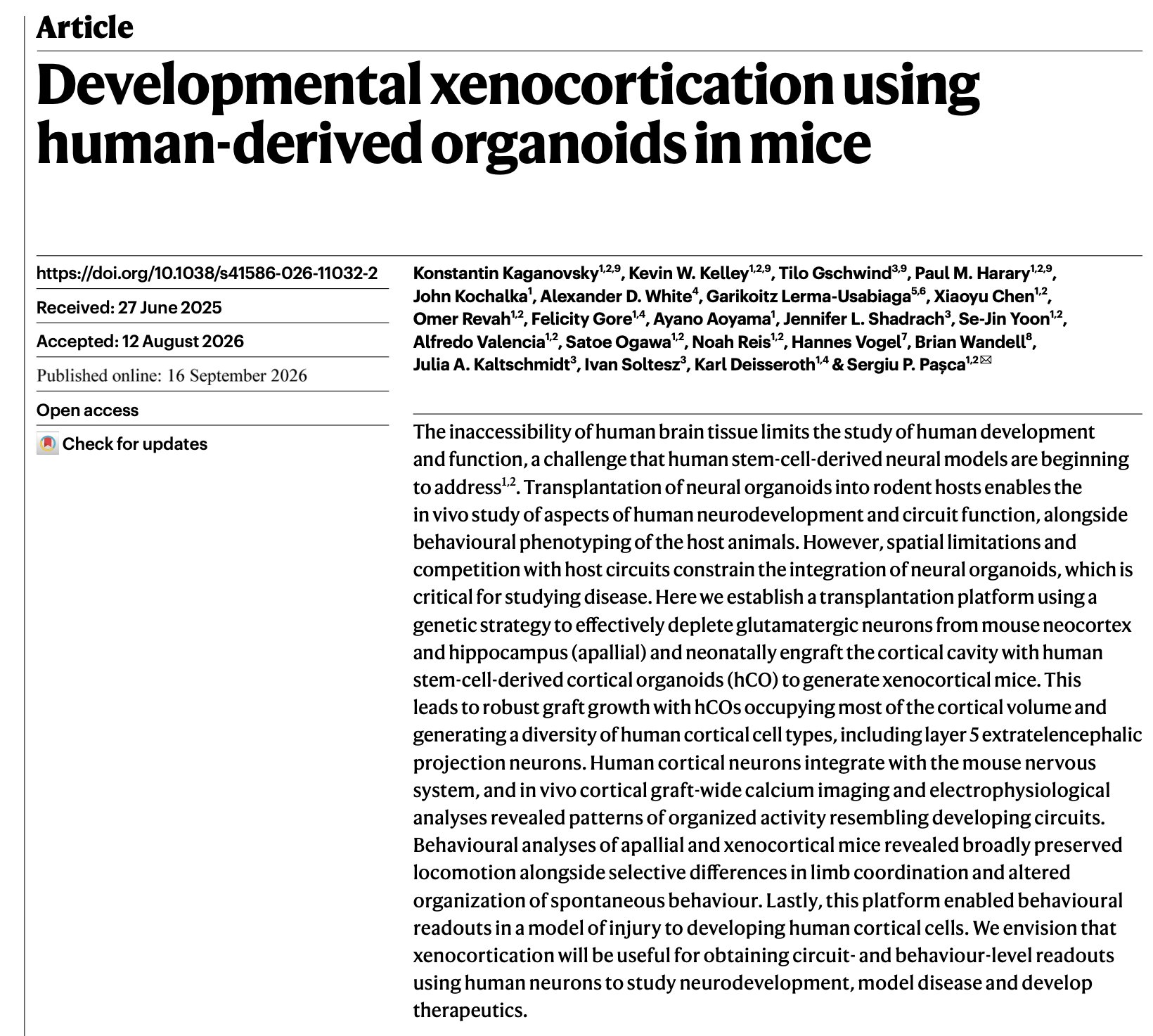
1/ I have long dreamed of systems that could causally model human neurobiology across scales, from molecular to behavioral.
In @Nature, delighted to share our efforts at creating xenocortical mice where human organoids grow to occupy most of mouse cortex.

13
66
397
37,300
Sergiu P. Pasca retweeted

Really cool new model out of the @Sergiu_P_Pasca lab at Stanford. They engineered mice missing most of their cortex and hippocampus, then transplanted human brain organoids into that space. The grafts matured, wired up with the host brain, and even rescued working memory deficits in the animals (now out in Nature).
Awesome piece in @TheScientistLLC by Mariella Careaga digging into it, happy to have contributed a few thoughts.
Check out the few story here: the-scientist.com/human-deri…

1
19
88
6,315
Sergiu P. Pasca retweeted

Stanford Bioengineering faculty search: Apply by Sept 30!
Bioengineering is defined broadly: if you are engineering at the level of biomolecules, cells, tissues, organisms, or using/developing advanced engineering techniques to study these systems - please apply!
facultypositions.stanford.ed…
2
52
160
32,865
Sergiu P. Pasca retweeted

We wrote a tutorial guide on voltage imaging, now out in Neuron: authors.elsevier.com/a/1nlgh…. Indicators, microscopes, and software have all advanced to the point that it's not so hard -- you can now directly watch the electrical activity of neurons in live animals or in culture.
2
41
176
14,965
This year, we captured our @Stanford @BrOrganogenesis hand-on workshop on human stem cell models course in action.
Every year here on campus, we share methods developed in our lab for generating and applying neural #organoids and #assembloids.
Mornings are devoted to lectures, while afternoons are spent at the bench: going from building assembloids to imaging them and recording their electrical activity. Throughout the week, students also work together in small groups on a project. This year, by popular demand, we focused on assembloids
This spring, 22 students came from around the world. They returned to their institutions and labs taking these methods with them and adapting them to their own research.
For us, the course is an invigorating lab-wide effort that we prepare for months in advance.
This year it was superbly organized by three outstanding scientists: Merve Avar, Sabina Kanton, and Rebecca Levy (who recently started her own lab at Stanford!).
One of the best weeks of the year for us in lab.
A glimpse of it in the video below.
piped.video/J-TJfdO11AQ?is=nikE…
1
1
17
3,964
Sergiu P. Pasca retweeted

Are you a high-achieving early career researcher? Apply to be a Global Scholar in our @CIFAR_News Brain, Mind, and Consciousness Program. CAD 100k unrestricted research support over 2 years, & access to an incredible network of peers and colleagues. cifar.ca/next-generation/glo… .@theASSC (pls share)
3
29
100
11,439
Last November, more than 70 scientists, ethicists, patient advocates, journalists, policymakers, and other members of civil society gathered at Asilomar to consider the future of neural #organoids, #assembloids, and their transplantation.
The report of the meeting is now out 👇
Across seven working groups, participants called for international, decentralized oversight that respects regional and cultural differences and can evolve alongside the science. The patient advocates were particularly clear: they do not want research slowed down, but they do want confidence that it is proceeding responsibly.
The report lays out a multi-year path toward building that infrastructure, continuously monitoring the field, developing practical guidance, and bringing scientists and society together as the science advances.

1
2
25
3,058
neuroscience.stanford.edu/ne…
Grateful to Hank Greely for organizing this with me, to everyone who contributed, and to the Dana Foundation and Wu Tsai Neurosciences Institute for supporting the convening, with Worldview Studio.
1
6
931
Stanford Report on what we learned and what comes next:
news.stanford.edu/stories/20…
4
417