

UK, Irish, EU citizen. Campaign to rejoin the EU. Give no quarter to the Tory Party. Promote integrity in public life. Dispel the darkness with facts + reason.
- Tweets 48,119
- Following 2,679
- Followers 2,289
- Likes 69,670


Michael Fifield 🇺🇦🇮🇪🇬🇧🤝🇪🇺🇮🇪 #FBPE retweeted

This is simply vile. Trump is a loser, and an embarrassment to our country.

1,652
1,489
9,997
1,474,177

This is the kind of depravity we are dealing with when we are dealing with Russians: liars, rapists and murderers. Am I right @RussianEmbassy? Russia should be ground into the mud via economic sanctions. And then we want to see trials at the ICC.

A boy on his bike near Kramatorsk was just murdered by a russian drone. They posted this video of their crime. This is evidence this war has nothing to do with territory. It’s an attempt to wipe out an entire civilian population of an innocent county while the world watches.

1
37
Vibes-meister, back-door Burnham, is starting to get on everyone’s tits, as we exchange serious government for government by TikTok and Instagram. Bring back @Keir_Starmer now.

Prime Minister, all due respect, can you stop wasting your time and ours with these cringe videos and tell us how you’re going to stimulate economic growth whilst also paying for all the things you’ve been promising? Thanks.
57
Michael Fifield 🇺🇦🇮🇪🇬🇧🤝🇪🇺🇮🇪 #FBPE retweeted

Prime Minister, all due respect, can you stop wasting your time and ours with these cringe videos and tell us how you’re going to stimulate economic growth whilst also paying for all the things you’ve been promising? Thanks.


1,217
1,047
12,948
1,795,589
Michael Fifield 🇺🇦🇮🇪🇬🇧🤝🇪🇺🇮🇪 #FBPE retweeted

I've always been a workaholic. But I have never worked at the pace I do now. Since the start of Russia's full-scale invasion of Ukraine, I haven't had a single day off. Some mornings I wake up feeling like I simply can't keep going. But somehow, I do. Honestly, I don't even know how.
I don't know how our Defenders endure it. I don't know how Ukrainians keep moving forward after daily Russian attacks and air raid alerts - how we keep working, living, and carrying on.
Alongside the work I do behind the scenes, I have also become a blogger - someone who speaks and writes about Ukraine and the Ukrainian experience every single day. I believe these daily posts are a weapon of their own. But they are also emotionally and intellectually exhausting, because every tragedy passes through me before and while I put it on social media.
Reading and listening are difficult experiences too. Some of you tell me in the comments that you read my posts every day. This shared experience is painful, as well. But it is also a source of support for all of us here. Because we are heard, and we have a voice. It gives us hope, and it is deeply human.
This might be a bit all over the place, but I just wanted to say thank you for reading and for supporting Ukraine.
315
632
4,580
72,259
I endorse this message: get the bins out on the 13 August for the Refuse Party. Make sure @Nigel_Farage goes into the bin of history.

Here it is. My manifesto for the 2026 Clacton By-Election. It's a once-in-a-lifetime opportunity. Join me, clean up Clacton and let's make 13th August Bin Day! #VoteBinface #VoteyMcVoteface #YesWeTinCan

42
Fair comment on back-door Burnham’s first few days in office: any reaction from you, @andyburnham - since you’re so keen on government by social media?

Finally, one of the mainstream media outlets has begun to examine Andy Burnham’s first week in office and the composition of his Cabinet.
Beth Rigby of Sky News, speaking on her podcast alongside former Scottish Conservative leader Ruth Davidson and former Labour leader Harriet Harman, highlighted the stark contradiction between Burnham’s repeated promises of unity and what has actually happened since he entered Downing Street.
Far from uniting the Labour Party, Burnham appears to have gone out of his way to promote those who led the coup against Keir Starmer and contributed to his downfall. The podcast itself invokes The Traitors, and the comparison is becoming increasingly difficult to dismiss. Those accused of disloyalty have been rewarded with government posts, while many of the talented and experienced figures who served loyally under Keir Starmer have been removed altogether.
A substantial section of the Labour Party has effectively been excluded from government in one form or another. This is precisely what Burnham said he would not do, yet within days of taking office he has done exactly that. In his own words, the reaction has gone down "like a bucket of sick". Those are his words, not mine.
There will clearly be no unity. As the weeks pass, these decisions will be examined more closely, and investigative journalists will begin digging ever deeper into the events that brought down Keir Starmer and installed Burnham in his place.
Questions must also be asked of Lucy Powell, who remains Deputy Leader of the Labour Party. When she stood for that position, she argued that it was not possible to serve effectively both as Deputy Leader and as a Secretary of State. We are therefore entitled to ask when she intends to relinquish one of those roles.
Lucy Powell, Lucy Haigh, Angela Rayner and, of course, John Healey, among others, appear to have been deeply involved in the events surrounding Starmer’s removal. The full story has not yet been told, but it will be. As scrutiny intensifies, further details will inevitably emerge.
Also, there are the Labour Party grassroots and its members, who have been clearly left out in the hope that the leadership can stabilise its position before the Party Conference. That conference will not proceed as smoothly as it has in the past. It has all the makings of a political bloodbath, a civil war of sorts, as those who feel excluded make their voices heard.
At some point, someone will break ranks and reveal what really happened. Someone will produce the messages, the conversations, or the evidence that finally exposes the full extent of it.
It may not happen today or tomorrow, but it will happen.
news.sky.com/story/is-the-bu…
1
23
Michael Fifield 🇺🇦🇮🇪🇬🇧🤝🇪🇺🇮🇪 #FBPE retweeted

You have still not answered the fundamental question. Where is the credible, fully costed plan to achieve defence spending of 3% of GDP, let alone the even greater ambitions now being suggested? Each time the question is put, the country is offered another slogan, but precious little by way of substance.
"Buy British by design" is an attractive soundbite, but government procurement cannot be conducted on sentiment alone. If British produced equipment is appreciably more expensive than an equivalent alternative, how will value for the taxpayer be protected? If the industrial capacity does not presently exist, where is the detailed strategy to rebuild it? Factories cannot be conjured into existence overnight, nor can skilled workforces and resilient supply chains be created by ministerial decree.
Britain no longer possesses the industrial base, the raw material resources or the global trading position that it once enjoyed. Rebuilding our manufacturing strength is both desirable and necessary, but it demands a coherent long term economic strategy, sustained investment, competitive energy costs, access to reliable supply chains and thriving export markets. Thus far, we have heard remarkably little about how those essential foundations are to be laid.
The greatest omission of all is that the Government scarcely dares utter the words "European Union". Like it or not, it remains our largest trading partner and the nearest market through which British manufacturers can most readily grow. Any serious industrial strategy that refuses even to acknowledge that reality begins on decidedly fragile ground.
Fine words are easily spoken. Grand promises are readily applauded. Delivering them is another matter entirely. Governments are not judged by the elegance of their slogans, but by the credibility of their plans. At present, the rhetoric is running well ahead of the reality.
@JohnHealey_MP

You will see this as a determined drive that you have not seen before from a British government.
Buying British not “if possible”, but by design. So every procurement pound supports British jobs, British apprenticeships and British skills. thesun.co.uk/news/39871373/j…
3
42
156
3,062
Michael Fifield 🇺🇦🇮🇪🇬🇧🤝🇪🇺🇮🇪 #FBPE retweeted
Parliament has now entered its summer recess.
As a result, Andy Burnham will not face Prime Minister’s Questions or any other regular parliamentary occasion on which he might be challenged over his legitimacy, his lack of a personal mandate or his intentions towards the manifesto on which Labour was elected in 2024.
He is instead spending his first days in office deciding upon the composition of his Cabinet, and there are already reports of internal disagreement. Ed Miliband has apparently fallen out with Burnham and may not be appointed Chancellor, despite pressure from sections of the trade union movement. At present, nobody outside the negotiations appears to know precisely what is happening.
The Conservatives, Reform UK and the Liberal Democrats are now waiting for their opportunity. Each will understand that Burnham’s lack of a personal mandate provides them with an unusually powerful line of attack. From the first day of his premiership, they will present him to the electorate as a man who entered Downing Street through an unprecedented political manoeuvre and a deliberate campaign against the sitting Prime Minister.
Reform UK must be considered especially seriously.
The party came second in the Manchester by election and has established a strong presence across many of the surrounding local authority areas. By the end of Burnham’s period as Mayor of Manchester, Reform appeared increasingly capable of mounting a credible challenge for the mayoralty itself.
This presents an important political contradiction. Manchester elected Burnham as its mayor, yet many communities across the wider area contain some of the strongest support in the country for Reform and for leaving the European Union. The politics of the region are sharply divided, and the strength of Reform’s support stands in direct contrast to the political image Burnham has attempted to project.
Reform has, however, experienced difficulties of its own. Nigel Farage is facing questions concerning his financial affairs and substantial sums of money that are alleged to remain insufficiently explained. At the same time, he has embarked upon a considerable political gamble by resigning as the Member of Parliament for Clacton and standing again in the resulting by election.
That decision could either strengthen or seriously damage him. Should Farage return with a commanding majority, many of the questions currently surrounding him and Reform may quickly recede. The party would return to the centre of political attention with renewed confidence, momentum and authority.
The Conservatives have benefited from Reform’s recent difficulties because those problems have allowed them to appear more relevant once again. A decisive Farage victory could reverse that process and push the Conservatives back towards political irrelevance.
Should Reform return strongly, it will be ideally placed to attack Burnham and the Labour Government. Although it has relatively few Members of Parliament, the party frequently punches well above its numerical weight in the House of Commons. A renewed surge of public support would galvanise its parliamentary presence and produce a sustained and coordinated attack upon Burnham.
For any opposition party, this is an extraordinarily powerful position from which to challenge a government. Every weakness, contradiction and failure will be seized upon far more aggressively than it ever was under Keir Starmer. Burnham will be judged not merely upon his decisions, but upon the manner in which he acquired the office in the first place.
Such a campaign would not remain confined to Westminster. Donald Trump would almost certainly seek to associate himself with it, and Elon Musk would be equally likely to intervene. Britain’s right wing press would hold nothing back. Every weakness, contradiction and failure within Burnham’s Government would be exposed, amplified and used relentlessly against him.
What we have seen from Burnham thus far is the politics of populism. In that respect, there are uncomfortable similarities between his political style and that of Nigel Farage. Burnham presents himself as the reassuring and benevolent Prime Minister who will spend billions of pounds improving welfare, public services and the lives of ordinary people. Yet he has not explained where the money will come from.
He insists that he will remain within the fiscal rules established under Keir Starmer, but it is difficult to understand how that can be reconciled with the spending commitments and political promises he has previously made. Burnham has repeatedly altered his position when circumstances have changed, and the opposition parties will be watching every statement for contradiction.
Their attacks will be relentless, and many of them will land heavily upon Burnham and his new Government.
There are also few genuinely commanding figures within the Burnham camp who appear capable of withstanding the political pressure that is coming. The left of the Labour Party will not necessarily remain united behind him. Some want Burnham to restore Jeremy Corbyn to the Parliamentary Labour Party, something that appears extremely unlikely to happen.
The internal conflict has therefore not disappeared. Burnham and Lucy Powell may say that the divisions of the past will now be brought to an end, but those divisions remain. We have already seen figures within Labour challenging or contradicting Burnham before he has even completed his first full day in office.
The public will also make its own judgement. People rarely respond warmly to those they regard as traitors or pretenders, and many will watch closely to see whether Burnham can justify the extraordinary manner in which he came to power.
For that reason, we do not believe he will remain Prime Minister until July 2029. At best, he may survive for approximately a year before being forced to seek a mandate through a general election, or before renewed infighting within the Labour Party begins to undermine his authority.
The claim that Labour’s internal conflict has ended is already being tested. Burnham is scarcely a day into the job, and the disagreements have begun.


Shabana Mahmood has been reappointed as Home Secretary @ukhomeoffice.

2
13
47
3,081
Note, everyone, that this cabinet minister is STILL blocking replies to her Tweets. This is absolutely unacceptable and contrary to the principles of open government. What does this tell you about the illegitimate Prime Minister, @andyburnham’s ‘government’.

Absolutely thrilled the be appointed Education Secretary.
For me there’s no more important job for any government than making sure young people have the best education, the best opportunities and the best future they can.
Lots to do and I look forward to getting started.
40
Michael Fifield 🇺🇦🇮🇪🇬🇧🤝🇪🇺🇮🇪 #FBPE retweeted
The sheer audacity of this email is difficult to comprehend.
To speak of unity while asking loyal members to recruit others, without first reflecting upon the events that have brought the party to this point, displays a remarkable lack of self awareness.
Unity cannot be proclaimed by circular email, nor can trust be restored by carefully crafted slogans. It is earned through honesty, humility and respect for those who have devoted years of service to the Labour Party.
Before urging members to bring others into the fold, the leadership would do well to ask why so many long standing supporters feel disillusioned, unheard and unable to recognise the party they once proudly served.
Until that question is answered with sincerity rather than rhetoric, appeals such as this will do little more than deepen the sense of disappointment felt by many.

49
180
493
10,580
Michael Fifield 🇺🇦🇮🇪🇬🇧🤝🇪🇺🇮🇪 #FBPE retweeted
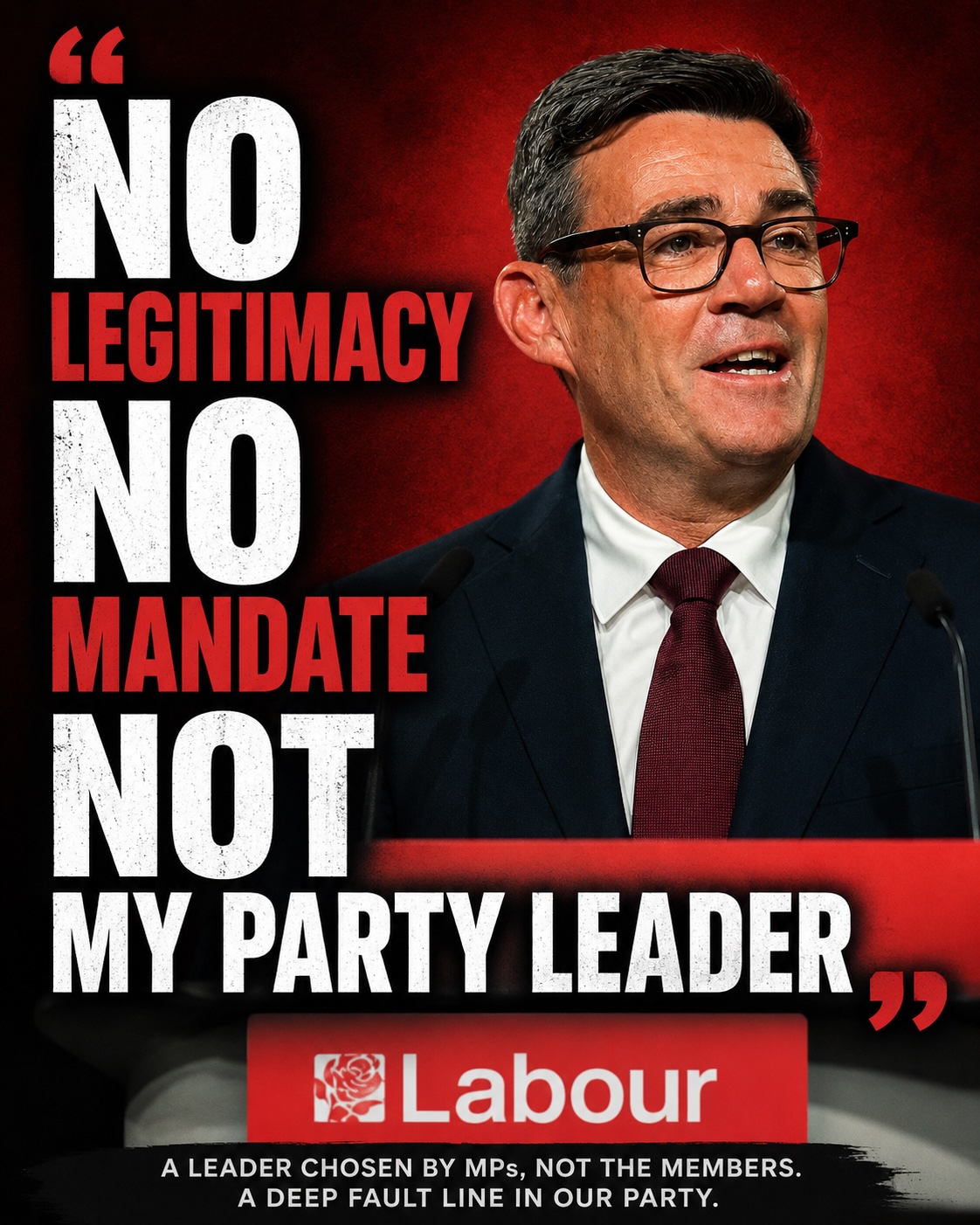
The papers speak of leadership and change. They speak of a commanding mandate and unquestionable legitimacy. Yet I have seen nothing thus far that justifies either claim. Leadership is earned through the confidence of those you seek to lead, and legitimacy rests upon a genuine mandate. In my view, Andy Burnham has yet to demonstrate that he possesses either.


7
60
198
2,219
Michael Fifield 🇺🇦🇮🇪🇬🇧🤝🇪🇺🇮🇪 #FBPE retweeted
Andy Burnham speaks of bringing the infighting within the Labour Party to an end. That is simply not going to happen. The manner in which he became Leader of the Labour Party, and is set to become Prime Minister on Monday, has, in my view, exposed a deep fault line between the Parliamentary Labour Party and the party's membership. He knows precisely how contentious the process has been.
While he may have secured the support of the Parliamentary Labour Party, that is not the same as securing the confidence of the wider membership. Many members feel they have been excluded from the decision, and those divisions are unlikely to disappear simply because he calls for unity. The gulf between the Parliamentary Labour Party and its members has not narrowed; it has widened.
There will, in time, be a reckoning in the court of public opinion and within the party itself. If those divisions persist, Andy Burnham may ultimately find that the manner of his ascent proves to be his greatest political liability.

Andy Burnham tells his party he wants to make five major changes to politics:
1/ bring an end to “infighting” within the party - warning Labour won’t win against the right unless it pulls together.
“Fighting to eradicate it and the insidious briefing culture that goes along with it will characterise my leadership.
In future, when a Burnhamite walks into a bar, I want the barman to say, ‘Great to see you. We don't like factional politics in here’.”
Burnham says he has not yet made final decisions about who will be in his cabinet. “When I have you will see it reflects all parts of our party - all communities.”
7
64
293
4,572
Michael Fifield 🇺🇦🇮🇪🇬🇧🤝🇪🇺🇮🇪 #FBPE retweeted

But no reference to party members.
You know..
The hard working foot soldiers who pound the streets leafleting and door knocking as well as raising funds and donating.
Absolutely no membership vote.
Also
The requirement for nominations to include 5% of branches has been ignored.

Andy Burnham cements Labour leadership with backing of 349 MPs bbc.in/4vq29qo
14
71
276
3,391
Michael Fifield 🇺🇦🇮🇪🇬🇧🤝🇪🇺🇮🇪 #FBPE retweeted
Melanie, your right to nominate Andy Burnham is beyond dispute. What is very much in dispute is your assertion that the Labour Party has somehow united behind him. That is not a statement of fact. It is a political opinion, and one that a vast number of Labour members simply do not recognise.
Louise Haigh has now publicly confirmed that planning for Andy Burnham's return began just over a year after Labour entered government and continued over the following year. That is an extraordinary revelation. It makes clear that this was not a sudden response to recent events, but a carefully developed process that unfolded over many months. Yet throughout that entire period the membership, the very people who give the Labour Party its strength, were never consulted and were never afforded any meaningful voice in determining the future leadership of their own party.
Thousands of members have already resigned. Many thousands more remain because they still believe the Labour Party is worth fighting for, but they do not recognise the picture you seek to paint. There is no great unity. There is a widening gulf between the Parliamentary Labour Party and a substantial section of its membership, and no amount of carefully chosen language can disguise that reality.
You entered Parliament only in 2024. With respect, that affords little authority to lecture the wider Labour movement about unity, democracy or the settled will of the membership. Many of those whose concerns you dismiss have devoted decades of their lives to the Labour Party, campaigning in difficult times, delivering elections, raising funds and sustaining the movement long before you took your seat at Westminster. They have earned the right to be heard, not ignored.
The Parliamentary Labour Party is not the Labour Party. It is one part of it. The membership are not an inconvenience to be managed, nor a backdrop to be acknowledged only at election time. They are the foundation upon which the party has always stood. To claim that the party has united, while so many members feel excluded from the very process that determined its future, is not merely premature. It is a profound misunderstanding of the movement you now claim to represent. History has shown that political parties which lose the confidence of their members rarely recover it by pretending the division does not exist.

Yesterday I nominated @andyburnham to be Leader of the Labour Party and our next Prime Minister.
This morning I told @SkyNews why I was proud to do so 👇

23
136
435
7,890
Michael Fifield 🇺🇦🇮🇪🇬🇧🤝🇪🇺🇮🇪 #FBPE retweeted

"Yesterday I nominated Andy Burnham to be Leader of the Labour Party and our next Prime Minister. This morning I told @SkyNews why I was proud to do so"
And then you turned off replies on X, @melanie_ward because you know how many Labour members and voters are furious.
Yesterday I nominated @andyburnham to be Leader of the Labour Party and our next Prime Minister.
This morning I told @SkyNews why I was proud to do so 👇
3
36
156
1,362
Michael Fifield 🇺🇦🇮🇪🇬🇧🤝🇪🇺🇮🇪 #FBPE retweeted

How disgraceful Dawn Butler.
“We got there in the end”
You, Louise Haigh and Lucy Powell and Burnham should be ashamed of yourself
You “got there in the end” because Keir Starmer got there for you by winning a GE that NONE of you could have won.
Show some respect
@LBC

43
186
738
16,015
Michael Fifield 🇺🇦🇮🇪🇬🇧🤝🇪🇺🇮🇪 #FBPE retweeted
Pippa, where was the journalism?
Louise Haigh has now publicly stated that plans for Andy Burnham's return were being discussed a full year before they came to fruition. If that is true, why was this not the biggest political story in Britain? Why was The Guardian not leading the investigation instead of merely commenting upon the consequences?This was never simply another Westminster story.
It concerned the manner in which the Leader of the Labour Party, and therefore potentially the next Prime Minister, would come to office.
The Guardian has long enjoyed unrivalled access to senior Labour figures, advisers and those at the very centre of political decision making. Are readers seriously expected to believe that a plan of such magnitude could have been in motion for an entire year without the newspaper hearing even the faintest whisper of it?
That stretches credibility to its limits.If the Parliamentary Labour Party had effectively determined the outcome before Labour members were given any meaningful opportunity to influence the choice, then this was one of the most important democratic stories of recent years.
Yet the newspaper that once built its reputation upon exposing what those in authority wished to conceal appeared content to observe events rather than investigate them.
Thousands upon thousands of Labour members have since resigned because they believe their voice no longer matters. That alone should have prompted searching questions and sustained investigation. Instead there was silence where there should have been relentless scrutiny.
So I ask a simple question. Did The Guardian fail to uncover one of the most significant political stories of modern times despite its exceptional access to the Labour Party, or did it know far more than it chose to publish while these events were unfolding?
Either answer raises profound questions about the present state of political journalism.
The Guardian once set the standard for holding power to account. Many readers are now entitled to ask whether that tradition has been abandoned when the story concerned those with whom it enjoyed its closest relationships.
MY ANALYSIS: Andy Burnham’s apology over Gaza marks a ‘reset moment’ as Labour seeks to win back progressive voters
theguardian.com/politics/202…
19
163
462
10,135
Michael Fifield 🇺🇦🇮🇪🇬🇧🤝🇪🇺🇮🇪 #FBPE retweeted

Big panic inside Reform Party Ltd circles as leaks from their WhatsApp show their own polling in Clacton has Binface leading and increasing his majority over Farage.
Talk of needing to "reframe media focus to immigrants and the boats"
313
1,331
9,766
567,097

