
Open Source Intelligence Monitor focused on Europe and Conflicts across the World. RT ≠ Endorsement. Want to Support my Work? ko-fi.com/osintdefender
Georgia, USA
- Tweets 64,115
- Following 1,681
- Followers 2,533,039
- Likes 63,413









Pinned Tweet

Today marks 25 years since the terror attacks on 9/11 back in 2001 that took the lives of nearly 3,000 Americans. What we saw in the minutes, hours, days, weeks, months, and years after was a collective coming together. Neighbor helping neighbor, families helping families, and first responders and our men in women in uniform making the ultimate sacrifice. Americans helping Americans.
Lest We Forget.

52
118
1,554
752,156
Ukrainian President Volodymyr Zelenskyy said Friday that President Donald J. Trump has made a final decision to grant Ukraine a license to produce Patriot air defense missiles. Zelenskyy said President Trump confirmed the decision during their meeting this week on the sidelines of the UN General Assembly in New York. Zelenskyy previously estimated that launching domestic production in Ukraine would take one to one and a half years once licensing is finalized.

President Trump and I had a meeting where we discussed general matters. After that, our negotiating teams held a separate, long meeting. The agreement is as follows: we will brief the European side and discuss these details with them; the Americans will speak with the Russians; and in ten days, we will come back with views and results in some shape or form.
As for a trilateral Ukraine-U.S.-Russia meeting, the American side proposed preparing it and meeting at the technical level. We are waiting for the United States to propose a date. The United States proposed the United Arab Emirates as the venue for such a meeting.
There are concrete agreements regarding Patriot licenses. At our meeting, President Trump stressed that he had made his final decision: Ukraine will receive licenses to produce Patriot missiles.
From answers to journalists’ questions. (1/3)
47
122
1,485
240,950
The U.S. Maritime Administration (MARAD), which oversees the country's merchant marine fleet, has ordered SUNY Maritime College to send its training ship "Empire State" into federal service. The ship normally serves as a floating classroom for maritime cadets, however MARAD has the authority to activate these vessels up for national missions.
Empire State departs the Bronx campus September 30, arrives in Norfolk, Virginia October 1, and will spend a month there getting its flight deck certified before moving into a support role for the Navy. That role hasn't been confirmed. MARAD expects the mission to last about 170 days.
The college's president says the decision was MARAD's alone, and he's pushing for the ship's return by mid-February so it doesn't disrupt cadets' required summer sea training. It's the first extended absence from campus since Empire State entered service in 2023.
Source: maritime-executive.com/artic…

10
47
734
142,534
Reportedly just test launches, but it should be noted that Iran has historically used “missile diplomacy” as their primary means of negotiation.

24
37
1,027
266,583
This comes amidst reports from Reuters that the U.S. and Iran are discussing a staged ceasefire system. However, per the report, once again, both sides are leverage is centered on the administration of the Strait of Hormuz and they are reticent to give up such leverage as a precondition for a ceasefire.


35
66
867
218,748
Trump-Xi Summit: What to Expect
ICOD- 0:725, 09/24/2026
(General Access)
BLUF:
U.S. President Donald J. Trump welcomed Chinese President Xi Jinping at Joint Base Andrews yesterday. Among other events, the two are expected to meet and discuss a wide range of issues, including the conflict in the Middle East, trade, and AI governance. China has also offered to act as a mediator between the U.S. and Iran. However, other Chinese coercive actions in the Western Pacific persist.
Key Points:
- Like past high level meetings between the two nations’ principal decision-makers, China set conditions for what can be publicly spoken about.
• The primary topic China has noted is Taiwan.
- China has warned the U.S. against fulfilling additional FMS to Taiwan. Current FMS-cases are on hold. Per U.S. Secretary of State Marco Rubio, such FMS is on hold to “make sure we have what we need first,” and not necessarily to appease China.
- A number of technical talks were held between U.S. and Chinese officials in the lead up to President Xi’s visit. U.S. Treasury Secretary Scott Bessent met with Chinese Vice Premier He Lifeng, where it was reported that agreements on AI governance were being negotiated.
- China and the U.S. have reportedly agreed to extend the trade war truce until January.
- China has offered publicly and privately to act as an intermediary between the U.S. and Iran. Specifically over the administration of the Strait of Hormuz and returning free and safe maritime traffic to the strategic maritime choke point.
- China continues coercive actions against the Philippines, a treaty U.S. ally, in the South China Sea. Most recently, China rammed a Philippine fisheries vessel attempting to bring supplies to fisherman in the locality.
- China continues to publicly lambast Japan, also a treaty U.S. ally, over their defense rejuvenation in response to an increasingly aggressive China. Both Chinese and Russian airborne and seaborne coercive actions, such as ADIZ and EEZ violations, persist.
- China continues to increase interoperability and military-to-military cooperation with Russia in the Western Pacific.
Key Judgements:
- Given the past results of high level summits between the U.S. and China and the public reports of cooperation in two key areas, it’s likely that joint declarations of cooperation, specifically on trade and AI governance will be the primary results of the summit between the two leaders. There is also a reasonable possibility that limited announcement on trade, pertaining to specific industries like agriculture, will be made as well.
- It’s unlikely that any major U.S. reversals over Taiwan policy will be announced, as China pressing the issue past the current FMS-cases on the books would open up a wider discussion of Taiwan’s sovereignty, something China is publicly reticent to do in the context of the meet.
Final Judgment: Long-Term
Given China’s continued coercive actions against treaty U.S. allies, continued cooperation with Russia, and persisting areas of competition between the U.S. and China, it’s unlikely that the summit will merit any long-term commitments that diffuse existing tensions between the two nations.
END

16
22
301
109,808
Video from @TocRadio shows Chinese press members pushing and shoving their way into position in spite of the protests of White House press members and the Secret Service.

167
273
2,599
487,755
OSINTdefender retweeted

SPECIAL REPORT EXCLUSIVE: Don’t miss the Iranian President TONIGHT 6pmET on @specialreport @foxnews #foxnews #specialreport #iran

1,235
107
506
190,303
U.S. President Donald J. Trump, as many assessed, has said that SI, or AI, will be one of the primary topics discussed by him and Chinese President Xi Jinping during their meetings.

34
46
755
122,016
A federal judge ordered the White House Thursday night to immediately reinstate press credentials for CNN, MS NOW, and Politico reporters, finding they were likely to succeed on their due process claims. Despite the order, a Politico reporter was reportedly denied entry to the White House this morning and had their credentials confiscated.
TV pool coverage of White House events has been suspended since Monday, when CNN was barred from the grounds on its assigned pool coverage day. The other four networks in the rotation (ABC, NBC, CBS and Fox) announced they would suspend coverage in response until the situation is resolved.
This mirrors the case brought by the Associated Press last year, when the wire service was restricted from certain White House events and lost its permanent seat in the briefing room, which was reassigned to be shared between two other services. The AP has since regained some access, but remains excluded from key spaces like the Oval Office and Air Force One while the underlying court case continues.
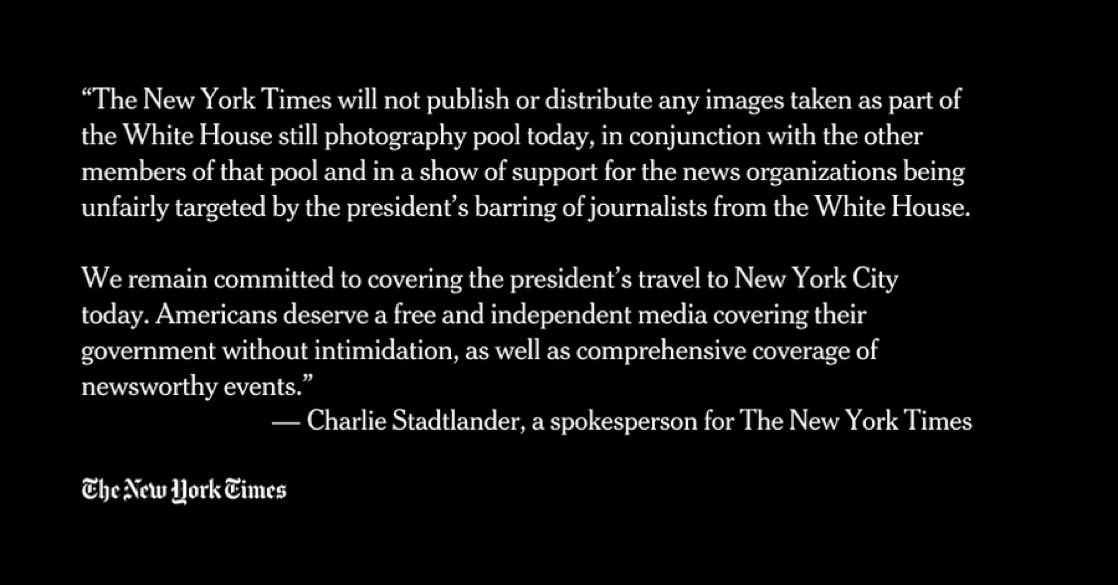
As the spate between key U.S. news outlets and the Trump administration progresses, the New York Times has said that they “will not publish or distribute any images taken as a part of the White House still photography pool today.” This follows CNN being barred from participating in their slated TV pool slot today by the White House and the subsequent boycott by major news outlets of White House pool coverage going forward.
44
59
591
196,874
The hacking group ShinyHunters claims it stole a large trove of sensitive FBI personnel data from FBIJobs.gov, the bureau's online jobs portal, according to the New York Times. The FBI has acknowledged the claim and says it's investigating, but has not confirmed the breach's scope or origin.
The group says the stolen data includes names, home addresses, phone numbers, spouses' names, and some medical information tied to current and former agents as well as job applicants. No data has been publicly leaked so far, though multiple media outlets have now reportedly seen portions of the hacked data.
ShinyHunters claims the hack isn't financially motivated and says it's retaliation for an FBI advisory warning about the group's harassment tactics, issued after ShinyHunters' earlier breach of the Canvas education platform. The group is demanding the FBI retract the advisory within a week. Cybersecurity firm Flashpoint says the group's past behavior suggests it will likely leak the data regardless. The hackers say they exploited a previously unknown flaw in Oracle's PeopleSoft software; Oracle did not respond to a request for comment.
Source: nytimes.com/2026/09/23/us/po…

23
79
516
114,582
OSINTdefender retweeted

As the state visit of Chinese President Xi Jinping kicks off in earnest today, our “What to Expect” assessment is now available for subscribers to @sentdefender.

3
42
42,501
OSINTdefender retweeted

An ongoing thread about Russian military action affecting Romania. Includes local news coverage and geolocations about all drone activity, going back to 2023.
This is the sort of ongoing archival work that is invaluable
@sentdefender @InsiderGeo @clement_molin @exit266

A drone entered 🇷🇴 in Botoșani, and crashed in Suceava County, close to Soloca.4 schools suspended classes
hotnews.ro/o-drona-a-intrat-…
1
13
76
62,802
According to U.S. Central Command, since the resumption of the blockade of vessels traveling to and from Iranian ports, 115 vessels have been redirected. Iran continues to target commercial shipping in the Strait of Hormuz.

14
29
309
111,998
OSINTdefender retweeted

OMG, DRAGO 51 (B-1B) just performed the most insane National Anthem flyover at Andrews today, definitely got Presidents Xi and POTUS attention! 🤣🇺🇸💪😎🔥

479
838
10,212
4,666,145
U.S. President Donald J. Trump welcomes Chinese President Xi Jinping at Joint Base Andrews. Tomorrow’s schedule is full of state events and dinners.

59
165
1,993
254,880
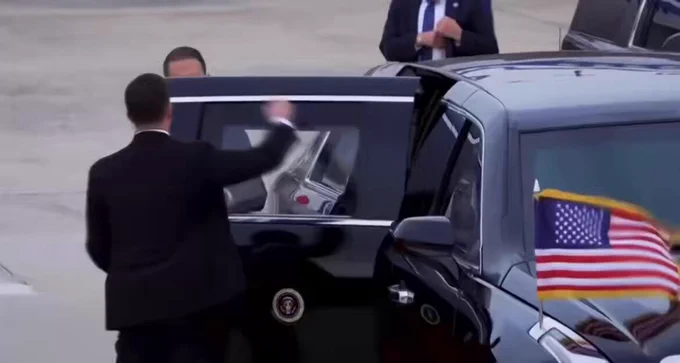
U.S. President Donald J. Trump exists the armored limousine, the Beast, to welcome Chinese President Xi Jinping at Joint Base Andrews.
52
69
1,461
205,508
